Fashion and progress never stand still. Let’s see what finishing and plumbing solutions in the bathroom are considered outdated in 2024, and what modern interior design can offer instead.
White Top, Dark Bottom

For a long time, Russian bathrooms have been dominated by a certain finishing scheme: darker tiles cover the lower part of the wall, lighter tiles cover the upper part, with a traditional horizontal border with ornamentation dividing them.

This solution will throw the interior of your bathroom back a decade; it is only appropriate if the design leans towards retro styling.

In place of the horizontal division into two colors, modern design suggests monochromatic finishing, a combination of tiles of different colors and textures following the principle of color blocking, highlighting one wall with contrasting tile or decorative panels. It’s customary to highlight the shower area, the wall above the bathtub, above the sink, or above the toilet, but not everything at once. Borders, undoubtedly, are becoming a thing of the past.
Photorealism
It turns out that modern design doesn’t completely abandon tiles with pictures. However, instead of photorealistic images of dolphins, beaches, bamboo, seashells, and flowers, neutral geometric abstractions and subtle botanical prints reminiscent of classic wallpaper patterns have taken their place.

Photorealistic images in 2024 also look out of place on shower curtains, towels, and bath mats; having just one such element is enough to cheapen the entire design.
Aggressive Colors
Pure colors reminiscent of children’s markers – bright red, purple, orange, fuchsia, acid green – such a riot of colors in the bathroom is morally outdated. Even pure white tiles look too aggressive, evoking uncomfortable associations with school and hospital showers.

Replacing straightforward shades are complex tones; they can be milky, pastel, or even rich and dark, but they must be muted.
Plastic Screen
Another way to cut costs in design is to cover the bottom of the bathtub with a plastic screen. Sometimes these screens also function as doors, allowing for additional storage space under the bathtub. This solution is practical but not aesthetic.

A contemporary replacement would be a screen made of ceramic tiles or natural wood, which withstands humid environments thanks to special treatments. The latter option can also be sliding.
If there is no need for additional storage space, the bottom of the bathtub can simply be left bare. White paint should help if the factory appearance of the model doesn’t suit you.
Baseboard at the Junction of the Bathtub and Walls
The junction of the bathtub and tiled walls is usually covered with a baseboard, similar to the junction of the kitchen countertop and backsplash. In the case of the bathroom, this role is typically fulfilled by a ceramic border or self-adhesive flexible plastic trim. While the former option isn’t so bad, the latter looks very cheap and tends to yellow over time.

Just as with kitchen countertops, the trendiest solution is to do without a baseboard. To achieve this, tiles need to be laid after installing the bathtub, essentially “embedding” the bathtub into the finishing. The tiles will then overlap the bathtub rim, and any gap will need to be filled with moisture-resistant grout.
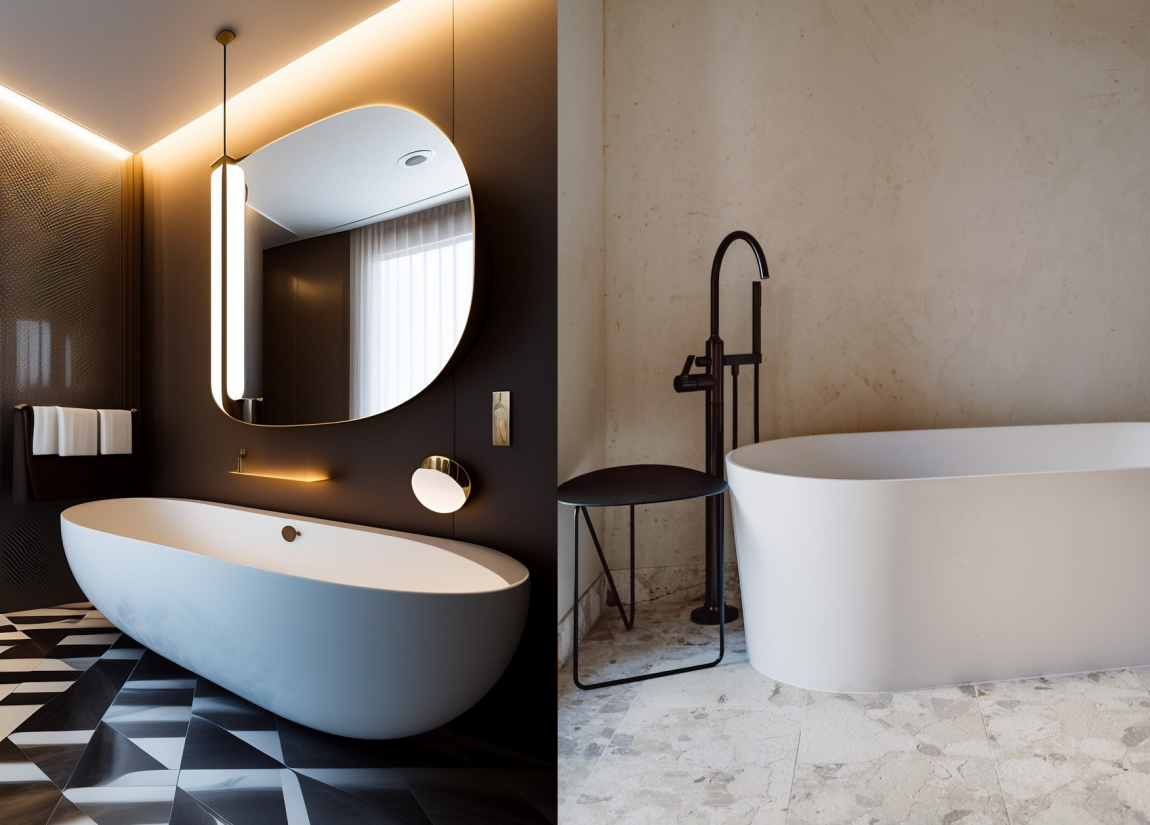
If the dimensions of the room allow, joints can be avoided altogether by opting for another trendy trend – a freestanding bathtub. This solution looks upscale and very impressive.
Shower Boxes
Capsular shower cabins reminiscent of space exploration technologies also fall into the category of “obsolete.”

They are very bulky, difficult to maintain, and the smart features like radios, lighting, and numerous other functions, as practice has shown, are not used as often as intended. Sleek shower cabins and open shower areas with built-in trays replace the fancy boxes.
Technical Room
Obsolete are not only technical and finishing solutions but also the attitude towards bathrooms in general. Previously, the bathroom was seen solely as a technical room; now it aspires to become a separate room.

A spacious bathroom can exist as a ladies’ boudoir or a home spa salon.
But even very small bathrooms can aspire to be relaxation rooms, thanks to carefully chosen decor: aromatic candles and diffusers, indoor plants, atmospheric lighting, aesthetic dispensers made of natural materials, a beautiful mirror, a soft rug – and voilà, this is already your favorite room in the house.